

Do You Need to Be a Triple Threat to Succeed in Musical Theatre?
By Daniel Sharpe – College Principal & Talent Agent
Published: 28 November 2026
One of the most frequently used terms in musical theatre training is 'Triple Threat'. It describes a performer who is capable of singing, dancing and acting. But does becoming a triple threat mean that you need to be equally accomplished in all three disciplines?
The professional industry is considerably more complex than that.
As a college principal and theatrical agent, I regularly encourage performers to consider something I call their Triple Threat Mix. Understanding this mix can help performers make better decisions about their training, auditions and professional career pathways.
Understanding the Triple Threat Mix
When explaining this concept to students, I use three transparent containers representing the three core disciplines of musical theatre:
-
Singing
-
Dancing
-
Acting
Each container represents a skill level on a scale of one to ten. For the purposes of this exercise, seven represents a professional standard, whilst a skill below five is unlikely to be sufficiently developed for roles that rely heavily upon that discipline.
This is a practical training exercise rather than a formal industry grading system.
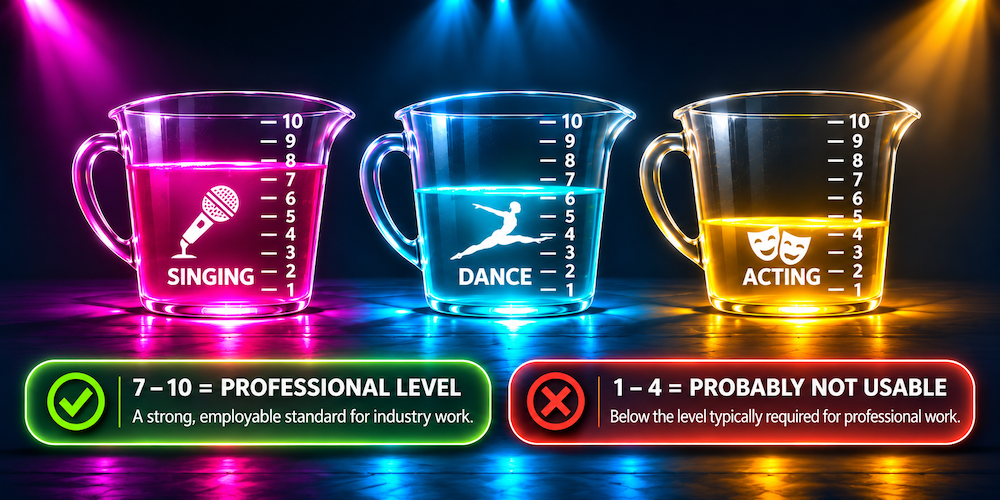
I encourage students to consider where their skills currently sit, where they would like them to be by graduation and what combination of skills could make them professionally employable.
What quickly becomes apparent is that no two performers are exactly the same.
Three Different Types of Musical Theatre Performer
Although every performer is an individual, we can broadly consider three different types of musical theatre performer.

The Dancer
A performer with exceptional dance ability, supported by competent singing and acting skills.
This performer may be particularly suited to dance ensemble roles in musicals, cruise ship production casts, commercial dance, international touring productions and specialist dance shows.
Developing their singing ability could significantly increase the number of professional opportunities available to them, particularly within musical theatre.
The Singer-Actor
A performer with strong vocal and acting abilities, supported by a functional level of dance.
This performer may be suited to principal musical theatre roles, vocal ensembles, cruise ship vocalist positions, pantomime, actor-led productions and international entertainment contracts.
Improving their dance ability may allow them to access productions that require greater physical versatility, even if they never become an exceptional technical dancer.
The All-Rounder
A performer with a strong and relatively balanced combination of singing, dancing and acting.
This performer may have access to a broad range of opportunities across musical theatre, cruise ships, resorts, pantomime and international entertainment.
However, versatility alone does not guarantee employment. An all-rounder must also consider what makes them stand out when competing against performers with exceptional ability in a particular discipline.
How Your Skills Translate into Professional Opportunities
Different professional contracts require different combinations of skills.
A cruise ship production dancer may need exceptional dance technique, strong performance skills and the ability to learn choreography quickly. A principal vocalist may need outstanding vocal ability, acting skills and sufficient movement capability.
A performer auditioning for a musical theatre ensemble may need to demonstrate a high level of competence across all three disciplines, whilst a pantomime performer may rely more heavily on acting, characterisation, singing and audience engagement.
The professional industry does not employ every performer against one universal set of requirements.
Understanding your Triple Threat Mix allows you to identify which opportunities are currently accessible to you and which additional skills could open new professional doors.
Where Should You Focus Your Training?
One of the most important questions a performer can ask is where an improvement in skill will have the greatest impact on their employability.
Imagine a dancer who scores nine in dance, seven in acting and four in singing.
Improving their dance ability from nine to ten would undoubtedly be valuable. However, developing their singing from four to seven could potentially open an entirely new range of professional opportunities.
Equally, a strong singer and actor who struggles with dance may not need to become an exceptional dancer. Developing sufficient dance ability to successfully navigate a professional movement audition could make a considerable difference to their career prospects.
Professional training should be about maximising individual potential, not simply delivering the same journey to every performer.
This is one of the reasons why individual feedback and personalised training are so important.
Understanding Yourself as a Performer
There is a difference between the performer you would like to become and the performer the industry is currently most likely to employ.
Understanding this difference does not mean abandoning your ambitions. It means recognising your current strengths, developing your weaknesses and identifying opportunities that allow you to gain professional experience whilst continuing to grow.
Many performers begin their careers in a different sector of the entertainment industry from the one in which they eventually achieve their greatest success.
Your first professional contract does not have to define your entire career.
Becoming an Employable Triple Threat
The aim of musical theatre training should not necessarily be to produce performers with three identical skill levels.
It should be to develop individuals who understand their abilities, recognise their professional value and possess the combination of skills required to access meaningful employment opportunities.
Every additional skill developed has the potential to increase the number of doors available to a performer.
Understanding your Triple Threat Mix is not about placing limitations on your career. It is about understanding how to expand your opportunities, maximise your potential and increase your probability of professional success.
Daniel Sharpe is the Principal of Sharpe Academy and founder of Agent Sharpe, specialising in professional musical theatre training, talent development, career pathways and the transition from vocational education into professional employment.
Further Reading
-

The Reality of a Musical Theatre Career: Why Talent and Training Alone Are Not Enough
The Reality of a Musical Theatre Career: Why Talent and Training Alone Are Not Enough Understanding the journey from vocational…
Read More
-

Does Class Size Matter When Choosing a Musical Theatre College?
Does Class Size Matter When Choosing a Musical Theatre College? Designing Training for Majority Success By Daniel Sharpe – College Principal…
Read More
-

Do You Need to Be a Triple Threat to Succeed in Musical Theatre?
Do You Need to Be a Triple Threat to Succeed in Musical Theatre? By Daniel Sharpe – College Principal & Talent…
Read More
- 1
-
The Reality of a Musical Theatre Career: Why Talent and Training Alone Are Not Enough
The Reality of a Musical Theatre Career: Why Talent and Training Alone Are Not Enough Understanding the journey from vocational… Read More -
Does Class Size Matter When Choosing a Musical Theatre College?
Does Class Size Matter When Choosing a Musical Theatre College? Designing Training for Majority Success By Daniel Sharpe – College Principal… Read More -
Do You Need to Be a Triple Threat to Succeed in Musical Theatre?
Do You Need to Be a Triple Threat to Succeed in Musical Theatre? By Daniel Sharpe – College Principal & Talent… Read More
- 1